
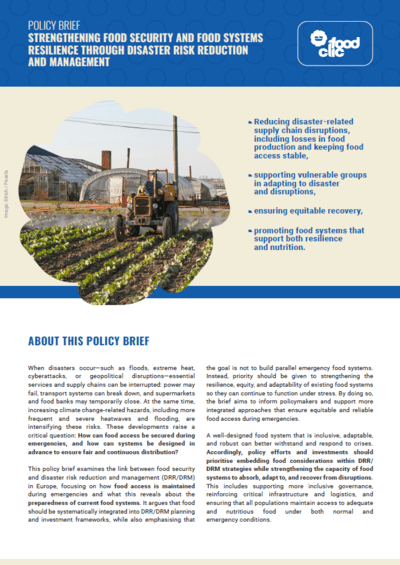
When disasters occur—such as floods, extreme heat, cyberattacks, or geopolitical disruptions—essential services and supply chains can be interrupted: power may fail, transport systems can break down, and supermarkets and food banks may temporarily close. At the same time, increasing climate change-related hazards, including more frequent and severe heatwaves and flooding, are intensifying these risks. These developments raise a critical question: How can food access be secured during emergencies, and how can systems be designed in advance to ensure fair and continuous distribution? This policy brief examines the link between food security and disaster risk reduction and management (DRR/DRM) in Europe, focusing on how food access is maintained during emergencies and what this reveals about the preparedness of current food systems. It argues that food should be systematically integrated into DRR/DRM planning and investment frameworks, while also emphasising that the goal is not to build parallel emergency food systems. Instead, priority should be given to strengthening the resilience, equity, and adaptability of existing food systems so they can continue to function under stress. By doing so, the brief aims to inform policymakers and support more integrated approaches that ensure equitable and reliable food access during emergencies.
Languages: English
Related City Regions
FOODCLIC. We are connecting people, food, policy & places.

FoodCLIC is a four-year project funded by the EU. The project runs from September 2022 to February 2027. The acronym FoodCLIC stands for 'integrated urban FOOD policies – developing sustainability Co-benefits, spatial Linkages, social Inclusion and sectoral Connections to transform food systems in city-regions
